What makes The Chicago 107 unique:
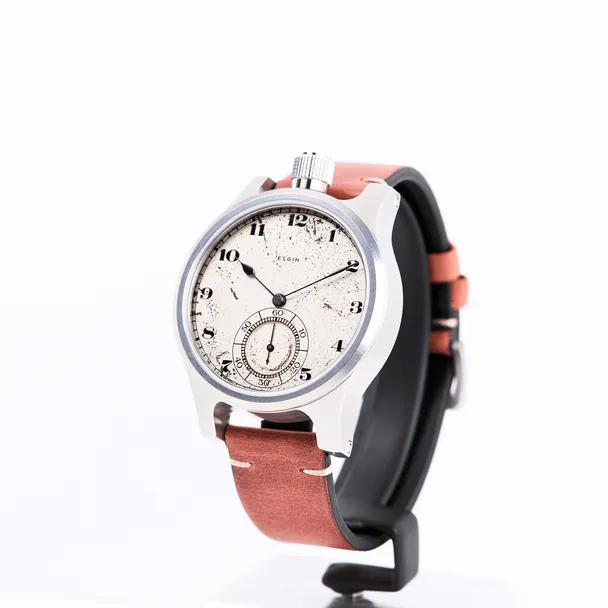
The Chicago 107 is defined by the quiet character of its original dial, whose surface has developed a rich, vintage patina over more than a century of use. Fine spotting and soft wear, what we affectionately call freckles, give the dial depth without obscuring clarity, allowing the bold black Arabic numerals to remain crisp and legible. A recessed sub-seconds dial at 6 o’clock introduces a subtle change in elevation and adds visual balance, while the original blued-steel hands sweep smoothly across the surface, their deep blue tone standing out against the warm, time-worn background. Together, these elements create a dial that feels honest, functional, and unmistakably antique.
Inside, this watch is powered by a 17-jewel Elgin movement, visible through the open caseback. The movement displays polished steel bridges, gold-plated gears, and carefully finished components that reflect the engineering discipline Elgin was known for during the early twentieth century. The layout is clean and purposeful, with a visual rhythm that emphasizes both reliability and craftsmanship—qualities that made Elgin movements a trusted choice in their era.
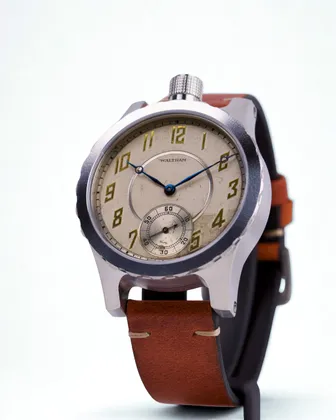
We housed this movement in a machined steel case with a matching machined steel angled bezel, a design that adds subtle dimensionality while maintaining a restrained, utilitarian profile. A knurled machined-steel crown provides tactile grip for winding and setting, and the watch is finished with a cognac leather strap that complements the warm tones of the dial while grounding the piece in a classic, wearable aesthetic.
The Elgin movement inside The Chicago 107 was manufactured in 1921, a year marked by a return to industrial momentum following World War I. American factories were retooling for peacetime production, refining manufacturing processes, and meeting renewed demand for reliable consumer goods. Watches from this period reflect that transition—built with proven engineering, practical design, and an emphasis on durability. The Chicago 107 preserves that moment in American manufacturing history, carrying it forward as a functional artifact of the early twentieth century.